
Why Is My Thread Bunching Underneath? A Beginner's Guide to Sewing Machine Bird Nests
Have you ever flipped your fabric over and discovered what appears to be a small thread monster living underneath?
You're sewing along happily. Everything seems fine. Then suddenly you lift your fabric and find a tangled mess of loops, knots, and thread spaghetti hiding underneath.
Congratulations. You've met one of sewing's most common beginner frustrations: Thread bunching
Also known as a bird's nest. The good news? This problem is usually much easier to solve than it looks.
And even better: It rarely means your machine is broken.
Let's make it make sense.
Quick Answer
If your thread is bunching underneath your fabric, the most common cause is an issue with the upper thread path.
In many cases, the machine needs to be completely rethreaded because the thread has slipped out of a guide, missed the tension discs, or wasn't threaded correctly.
The bunching appears underneath the fabric, but the cause is often happening above the needle.
Why Thread Bunching Feels So Confusing
The location of the problem is not always the location of the cause.
This is one of the first sewing lessons that surprises beginners.
When thread bunches underneath fabric, most people immediately assume: "The bobbin must be wrong." Sometimes it is. But often it isn't.
Sewing machines create stitches by balancing two threads:
upper thread
bobbin thread
When one thread loses proper tension, the balance breaks.
The machine responds by creating loops and tangles. What you're seeing underneath the fabric is often the result of something happening in the upper thread path.
Machines respond to inputs. And this is one of their favorite ways of telling you something changed.
Before You Adjust Anything, Ask One Question
What changed?
This is the foundation of the Sew What Debug Method™.
Before touching every dial on the machine, pause.
Ask:
Was the machine sewing correctly a few minutes ago?
Did I change thread?
Did I replace the needle?
Did the thread spool catch?
Did I rethread recently?
Many sewing problems become easier to solve once you identify what changed before the issue started.
Calm observation beats panic-adjusting every setting.
The 5 Most Common Causes of Thread Bunching Underneath
1. The Machine Wasn't Threaded Correctly
This is the most common cause by far.
Thread may have:
skipped a guide
missed the take-up lever
slipped out of the tension discs
Even experienced sewists occasionally miss a step while threading.
The solution: Completely rethread the machine from the beginning. Not partially. Not just the section that looks suspicious.
Start over and follow the full thread path carefully. Version one is data.
2. The Machine Was Threaded With the Presser Foot Down
Many beginners don't realize this matters. When the presser foot is down, the tension discs are closed.
This makes it difficult for the thread to seat properly. If the thread never enters the tension system correctly, tension problems often follow.
Check:
Before threading:
✔ Presser foot up
Then rethread the machine.
This tiny detail solves an astonishing number of sewing problems.
3. The Upper Thread Lost Tension
Sometimes thread slips. Sometimes it catches. Sometimes it jumps out of a guide while you're sewing.
The result? Loose loops underneath the fabric.
Check:
Follow the thread path visually.
Look for:
thread outside a guide
thread wrapped around the spool pin
thread caught somewhere unexpectedly
Sometimes the culprit is surprisingly simple.
4. The Bobbin Was Inserted Incorrectly
Yes, sometimes it actually is the bobbin.
Check:
Is the bobbin facing the correct direction?
Is the thread seated properly in the bobbin tension slot?
Is the bobbin wound evenly?
A poorly loaded bobbin can create inconsistent stitch formation.
The machine is trying to maintain balance. The bobbin plays an important role in that system.
5. The Needle Needs Attention
A bent, dull, or incorrectly installed needle can create all kinds of strange sewing behavior. Including thread bunching.
Ask:
Is the needle old?
Is it bent?
Is it inserted fully?
Is it facing the correct direction?
Needles are often overlooked because they seem simple. But they are one of the most important variables in stitch formation.
What You Should NOT Do
Do not immediately start turning the tension dial randomly.
This is the sewing equivalent of trying to fix a computer by pressing every button at once.
Could it work? Technically.
Will it help you understand the problem? Probably not.
Instead:
Stop sewing.
Ask what changed.
Check threading.
Check the needle.
Check the bobbin.
Test again.
One variable at a time. We don't guess. We debug.
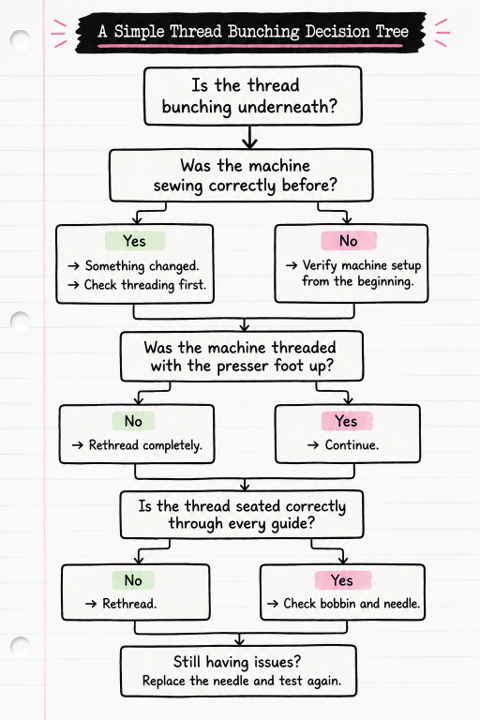
A Simple Thread Bunching Decision Tree
Why Understanding Matters More Than Memorizing
One of the biggest confidence shifts in sewing happens when beginners stop treating problems like mysteries.
Because most sewing problems follow patterns. Thread bunching is not random. The machine is responding to something. Your job isn't to panic. Your job is to investigate.
Once you understand how stitches form and how thread moves through the machine, troubleshooting becomes far less intimidating.
The goal isn't memorizing every possible sewing problem. The goal is learning how to think through them calmly. Because confidence doesn't come from never having problems. It comes from knowing how to approach them when they happen.
What You Should Do Next
If you've ever looked at a tangled mess of thread and thought: "I have absolutely no idea what I'm doing wrong." You're not alone.
Your machine is giving you clues.
Download the free Sew What Debug Guide and learn how to troubleshoot sewing problems without the guesswork.'
Inside you'll find:
"If X Happens → Check Y" flowcharts
tension troubleshooting maps
beginner-friendly decision trees
simple debugging prompts
So the next time your machine starts communicating through thread spaghetti, you'll know exactly where to begin. Because sewing isn't random. And neither is troubleshooting.
