
What Does a Sewing Machine Presser Foot Actually Do?
When you first start sewing, there are a lot of sewing machine parts you're told to use without anyone really explaining why.
Raise this lever. Turn this wheel. Lower this thing. Don't touch that thing. And somewhere in all of those instructions is the presser foot.
You probably know you're supposed to lower it before you sew. You may even know you're supposed to raise it before you take your fabric out. But what is that little metal foot actually doing down there?
At first glance, the answer seems pretty obvious. It presses on the fabric. Excellent. Blog post over.
Except there's actually a little more happening, and once you understand it, a few other sewing-machine mysteries start making sense too.
So let's talk about what your presser foot is actually doing—and why forgetting about it can lead to some very interesting behavior from your sewing machine.
So, What Does the Presser Foot Actually Do?
The simplest answer is that your presser foot holds your fabric against the feed dogs so the machine can move the fabric through evenly while you sew.
That's really its main job. But the important part is understanding that the presser foot isn't actually moving your fabric. Your feed dogs are.
If you look underneath the presser foot, you'll see those little textured metal bars poking up through the needle plate. Those are the feed dogs, and they're the part of the machine responsible for moving your fabric forward.
As you sew, they come up, grip the fabric, move it a tiny distance, drop back down, and repeat the process.
The presser foot applies gentle pressure from above so the feed dogs underneath can get a good grip. So basically, your fabric is hanging out in the middle of a very organized little sandwich.
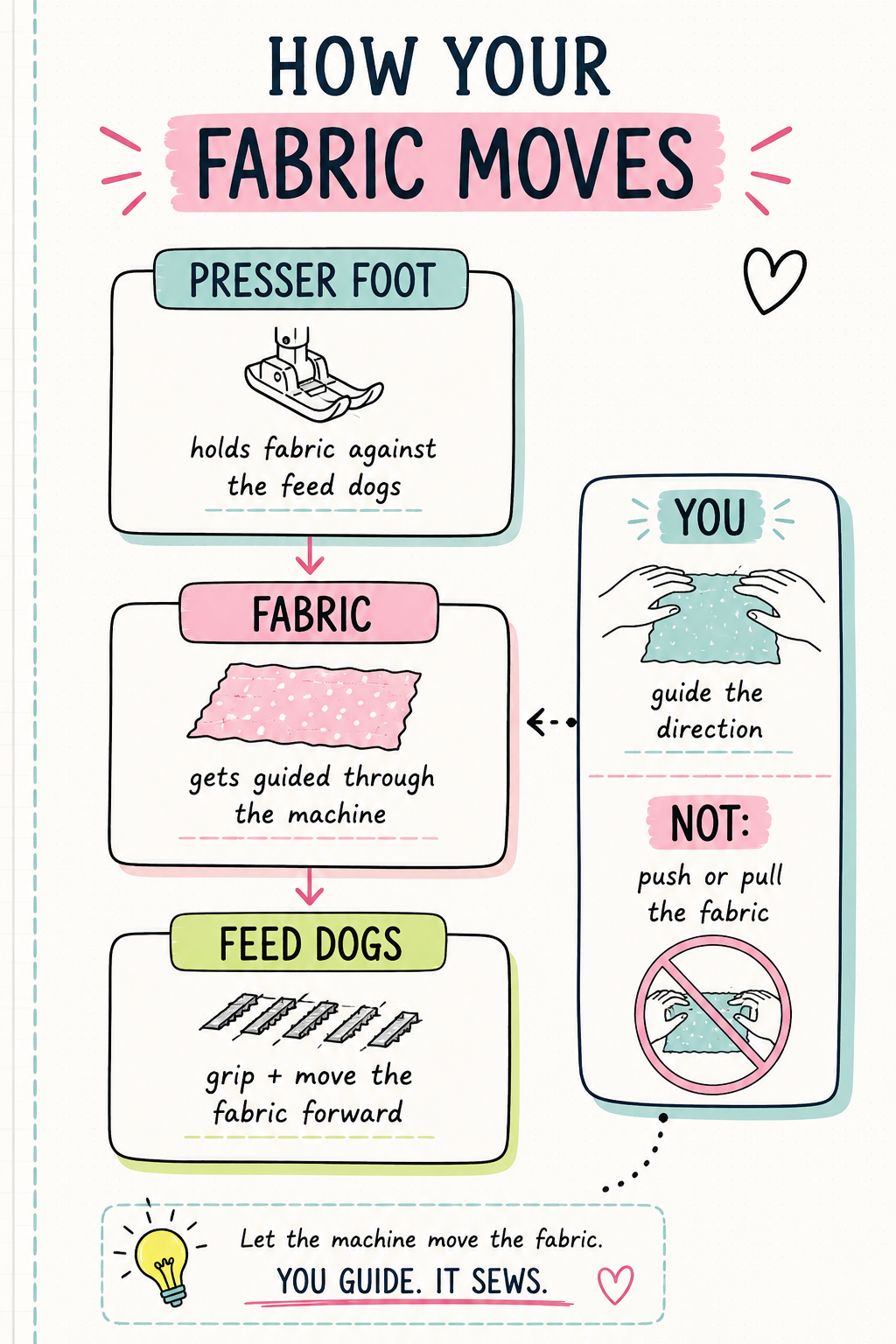
Presser foot on top. Fabric in the middle. Feed dogs underneath. One holds. One moves.
And together, they keep your fabric traveling through the machine at a nice, controlled pace. Once you understand that relationship, something else becomes much clearer.
You Don't Have to Push the Fabric
This is something I think almost every beginner does at some point. You sit down at the machine, start sewing, and instinctively feel like you should be helping the fabric along.
So you push a little from the front. Or pull a little from the back. After all, you're the one sewing. Surely you should be doing something.
But your machine already has a system for moving the fabric. That's what those feed dogs are doing. Your job is really just to guide it. Think steering, not pushing.
You want to gently keep the fabric going where you want it to go, but you don't need to force it through the machine. Pulling from behind can even cause the needle to bend or deflect slightly, which can create a whole new problem.
And we don't need to manufacture additional sewing problems. The naturally occurring ones will keep us plenty busy. Let the feed dogs move the fabric. You just help it stay on course.
What Happens If You Forget to Lower the Presser Foot?
Ah, yes. This one. You've lined everything up. You've threaded the machine. You're ready to sew. You press the pedal. And suddenly things are not going according to plan.
The fabric isn't feeding correctly. The stitches look strange. Thread may start tangling. Your machine begins making noises that cause you to reconsider every decision that led you to this moment.
Before you panic, check the presser foot. Is it down?
If the presser foot is still raised, your fabric isn't being held firmly against the feed dogs. The machine is trying to move the fabric, but one part of the system isn't in the position it needs to be.
That's why presser foot down before sewing isn't just one of those sewing rules somebody made up years ago. There's a mechanical reason for it.
The system works when the pieces are where they're supposed to be. Machines respond to inputs. Even when the input was, "Oops, I forgot to lower the foot."
But Here's Where It Gets Interesting
The presser foot lever has another job that beginners often aren't told about.
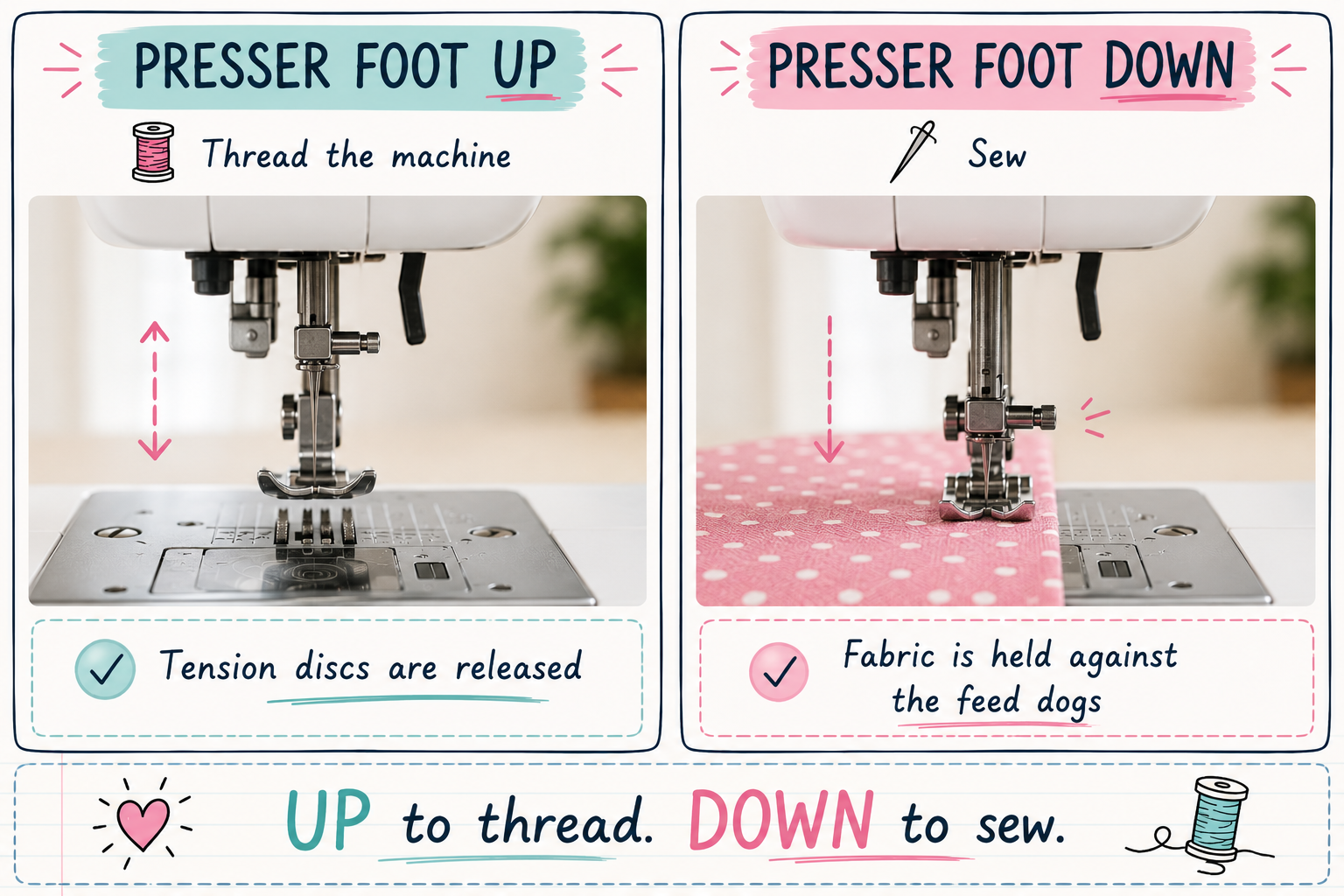
On many sewing machines, raising the presser foot also releases the upper thread tension discs. This is why I tell beginners to raise the presser foot before threading the machine.
When the presser foot is raised, the tension discs can open so the thread can slide into the correct position between them. Then you lower the presser foot before you start sewing, and the tension system engages.
This gives us one of those wonderfully simple sewing sequences that's much easier to remember once you understand why you're doing it:
Presser foot UP when threading.
Presser foot DOWN when sewing.
If you've read my post about how to thread a sewing machine, you may remember this coming up there too.
It's one of those tiny details that can make a surprisingly big difference. And this is exactly why I like understanding the mechanics instead of just memorizing instructions.
"Raise the presser foot when threading" feels like another rule to remember. "The tension discs need to open so the thread can get between them" actually makes sense.
What About All Those Other Presser Feet?
Then, just when you've gotten comfortable with your regular presser foot, you discover there are approximately 47,000 other kinds.
Zipper feet. Buttonhole feet. Blind hem feet. Walking feet. Overcasting feet. Feet that look perfectly normal and feet that look like tiny pieces of farm equipment.
Don't panic. You do not need to collect every presser foot known to humanity before you're officially allowed to sew.
The basic all-purpose presser foot that came with your machine can handle a lot of beginner sewing. The specialized feet simply make certain jobs easier.
A zipper foot, for example, lets you sew closer to the edge of a zipper than your regular presser foot can. A buttonhole foot helps you make consistent buttonholes. A walking foot helps feed multiple layers of fabric more evenly.
They're tools for specific jobs. That's all. As you start making projects that require them, you can learn them one at a time.
Otherwise, you end up with a little plastic box full of oddly shaped metal objects and absolutely no memory of what half of them do. Which, admittedly, is also a sewing milestone.
Does the Presser Foot Determine My Seam Allowance?
Not exactly, although it can help you sew consistently.
When you're following a pattern, you'll usually use the markings on your needle plate as a guide for your seam allowance. Depending on your machine and the presser foot you're using, the edge of the foot can sometimes be a useful visual reference too.
But remember what's happening underneath all of this. The feed dogs are moving your fabric. The presser foot is keeping it in contact with those feed dogs.
And you're gently guiding the edge of the fabric along your seam allowance marking. Everybody has a job. When everybody does their job, sewing gets considerably less dramatic.
What Is Presser Foot Pressure?
You might also come across the term presser foot pressure, which sounds like we're discussing whether your presser foot is experiencing workplace stress. We're not.
Presser foot pressure simply means how firmly the presser foot presses the fabric against the feed dogs. Some machines let you adjust this. Some handle it automatically. Some don't give you much control over it at all.
For most basic beginner sewing, you probably don't need to think about it very much. It becomes more useful when you're working with fabrics that don't feed normally—maybe something very thick, very delicate, or stretchy.
But this isn't a setting I'd recommend immediately changing every time your fabric acts funny. Check the simple things first:
Is the presser foot down?
Are you using the right needle?
Is the machine threaded correctly?
Is the fabric being guided instead of pushed or pulled?
Then we can start investigating other variables. We don't guess. We debug.
It's a Small Part of a Bigger System
The presser foot seems like such a simple little part of your sewing machine, but I think understanding it is a perfect example of why sewing gets easier when someone explains what's actually happening.
You could simply memorize: Lower the presser foot before sewing.
Or you could understand that the presser foot holds your fabric against the feed dogs so they can move it evenly.
You could memorize: Raise the presser foot before threading.
Or you could understand that raising it allows the upper tension system to release so the thread can settle into place.
The second version gives you something much more useful than a rule. It gives you a reason. And reasons are incredibly helpful when something eventually goes wrong.
Because your sewing machine isn't a mysterious box deciding whether it feels cooperative today. It's a system.
The presser foot holds the fabric. The feed dogs move it. The needle carries the upper thread through it. The hook catches that thread underneath. And all of those little jobs work together to make a stitch.
Once you start seeing your sewing machine that way, troubleshooting gets a whole lot less intimidating. You stop thinking, My machine hates me.
And start thinking, Okay. Which part of the system should I check? That's a much better question. And usually a much faster route back to sewing.
Want to Understand Your Sewing Machine Without All the Overwhelm?
If you're still looking at your sewing machine wondering what half of the knobs, levers, and moving parts actually do, you're exactly who I created the Sew What Debug Guide for.
It's a free, step-by-step guide that walks you through the basics—from getting comfortable with your machine and gathering the tools you actually need to making those first stitches without feeling like everyone else received a sewing instruction manual you somehow missed.
→ Download the Free Sew What Debug Guide
You don't have to understand everything at once. Just learn the next piece of the system. Then the next one. Before long, the whole thing starts making sense.
