A sewing machine sounds like an amazing gift. Until you actually try to buy one.
Suddenly you're standing in front of machines advertising 17 stitches, 70 stitches, 200 stitches, automatic this, computerized that, heavy duty, quilting, embroidery...
And you don't sew. So naturally, the machine with 200 stitches must be better than the one with 30.
Right?
Not necessarily.
If you're buying a sewing machine for someone who's learning—or someone who wants to get back into sewing—the goal isn't to find the machine with the longest feature list.
It's to find a machine they'll actually feel comfortable using. So before you put a sewing machine under the Christmas tree, let's talk about what actually matters. And don't worry.
You don't need to know how to sew to make a smart choice.
Start Here: What Does She Actually Want to Sew?
This is the most important question you can ask.
Not: "What's the best sewing machine?"
But: "What's the best sewing machine for what she wants to make?"
Because those aren't necessarily the same thing.
Someone who wants to hem pants, make simple clothes and sew throw pillows has very different needs from someone who wants to make quilts, sew bags from thick materials or embroider names onto everything she owns.
Before you shop, try to figure out what sounds most like her:
Clothing
Quilting
Bags and accessories
Home décor
Mending and alterations
Crafts
Costumes
A little bit of everything
Embroidery
If she doesn't know yet? That's completely fine. Look for a good general-purpose sewing machine that lets her learn the basics without overwhelming her.
Don't Get Distracted by the Number of Stitches
This is probably one of the easiest traps to fall into when you're buying a sewing machine. One machine has 30 stitches. Another has 200. Clearly 200 is better.
Except a beginner is probably going to spend a whole lot of time using:
Straight stitch.
Zigzag stitch.
And a handful of other practical stitches. Decorative stitches can absolutely be fun, but the sheer number of stitches shouldn't be the reason you choose one machine over another.
A beginner doesn't need hundreds of choices. She needs a machine that makes the important choices easy to understand.
Mechanical or Computerized?
You'll generally run into two broad categories while shopping.
Mechanical sewing machines
These usually have physical knobs or dials for things like stitch selection, stitch length and stitch width. There's something I really like about that for beginners:
You can see what you're changing.
Turn this dial. The stitch gets longer. Change this setting. The stitch gets wider. It can make the relationship between the machine's settings and the resulting stitch easier to understand.
Mechanical machines can also be a good option for someone who looks at a screen full of buttons and immediately thinks: "Nope."
Computerized sewing machines
Computerized machines use electronic controls and usually have a screen.
They may offer conveniences such as:
Speed control
Needle up/down
Automatic stitch settings
One-step buttonholes
More stitch choices
Other automated features
For some beginners, those features actually make sewing feel less intimidating. For others, more buttons just mean more things they're afraid to touch.
Neither type is automatically better. Think about the person you're buying for. Would she rather turn a dial and physically see what changed?
Or would she appreciate a machine that handles some of those decisions for her? That's a much better question than simply asking which machine has more features.
Features I Would Actually Look For
If I were helping someone choose a first sewing machine, there are a few features I'd care about much more than 150 decorative stitches.
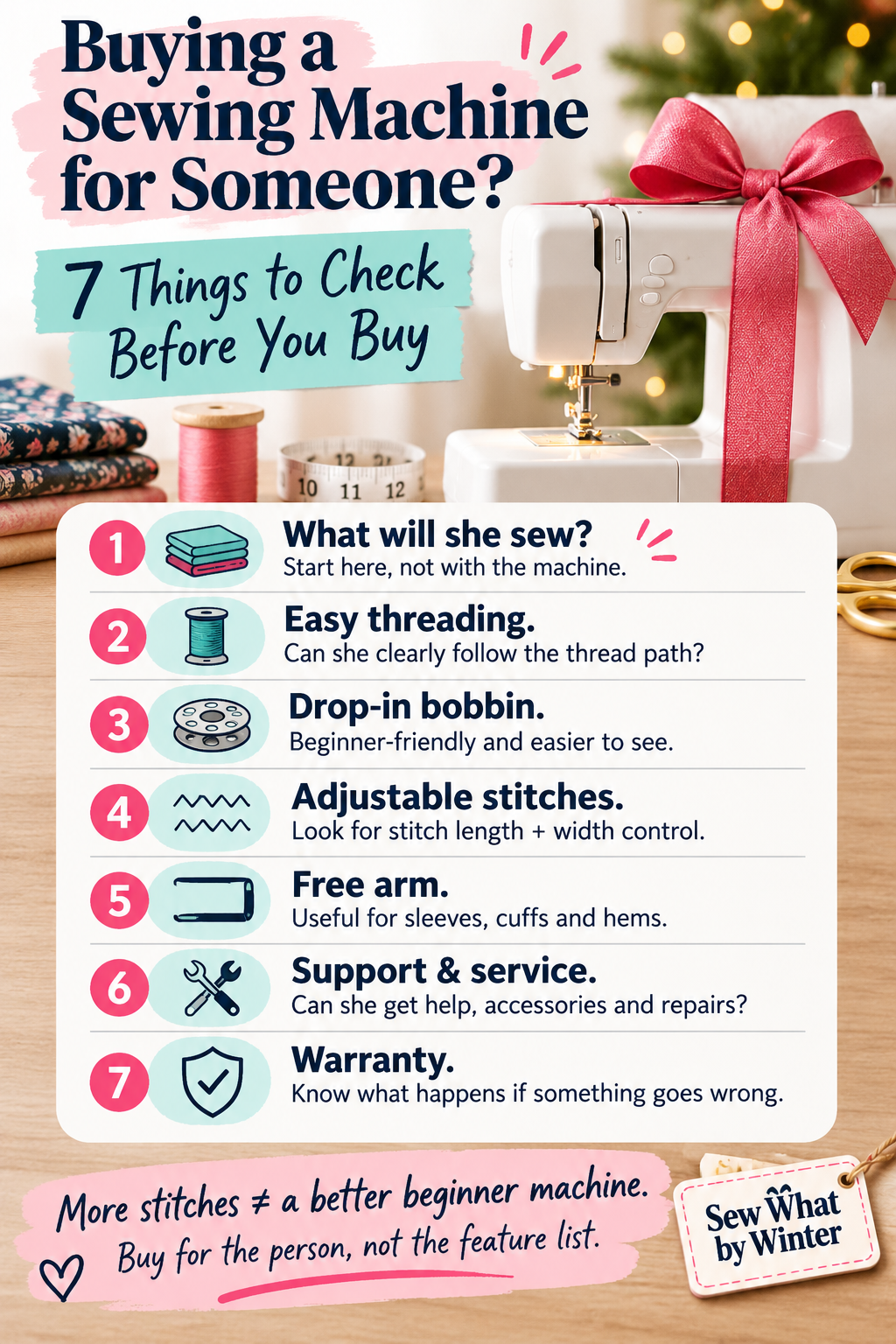
An easy-to-follow threading path
Threading is one of the first things a new sewist has to learn. Look for a machine with a clearly marked threading path. Numbers, arrows and diagrams printed directly on the machine are incredibly helpful.
Because when stitches suddenly look strange, one of the first things I want a beginner to be able to do is: Completely rethread her machine confidently.
A top-loading, drop-in bobbin
With a drop-in bobbin, the bobbin sits underneath a cover in the machine bed.
Many have a clear cover, which lets you actually see what's happening down there—and sometimes see when you're getting low on bobbin thread.
For a beginner, visibility is useful. Mystery compartments? Less useful.
Adjustable stitch length and width
I want a beginner to eventually understand that stitches aren't just "right" or "wrong." Different situations call for different stitch settings.
Being able to adjust stitch length and width gives her room to learn how those settings affect the finished stitch.
A free arm
Part of the machine bed usually removes to expose a narrower sewing area called the free arm.
That makes it much easier to sew things like:
Sleeves
Pant hems
Cuffs
Other small circular openings
It's one of those features that doesn't sound terribly exciting on the box. Then you try to hem a tiny pant leg without one. Suddenly it's exciting.
A buttonhole function
If she eventually wants to sew clothing, a buttonhole function is worth having.
A one-step buttonhole is especially convenient because the machine completes the buttonhole without requiring the user to manually work through several separate stages.
Speed control
This isn't essential, but I really like it for nervous beginners when it's available. A speed-control slider lets you limit how fast the machine can sew.
That means she can press the foot pedal without the machine suddenly taking off like it has somewhere else to be.
For someone learning how to guide fabric, turn corners and control the machine, slowing everything down can make sewing feel much less intimidating.
A built-in needle threader
Necessary?
No.
Nice?
Absolutely.
Especially if eyesight, hand dexterity or threading that tiny needle eye is likely to be frustrating.
What About a "Heavy Duty" Sewing Machine?
Don't assume heavy duty = better. Ask what she's actually going to sew.
If she's interested in heavier fabrics, bags, denim, canvas or multiple thick layers, then looking at machines designed to handle heavier work makes sense.
But if she's mostly interested in quilting cotton, beginner clothing projects, pillow covers and everyday sewing, don't buy a heavy-duty machine just because the name sounds impressive.
Buy for the sewing she's likely to do. Not the toughest sewing machine challenge you can imagine.
Think About the Machine After Christmas Morning
This is something I'd pay a lot of attention to. What happens when she can't figure out how to thread it? Or needs another presser foot? Or the machine needs service? Or she loses the manual?
Before buying, look at the support surrounding the machine.
Can you easily find:
The instruction manual online?
Manufacturer tutorials?
Replacement bobbins?
Presser feet and accessories?
Needles and common supplies?
Customer support?
A repair or service option?
A machine can have fantastic specifications and still be a frustrating first machine if getting help with it is difficult. And this is one reason buying from a sewing-machine dealer can be worth considering.
Some dealers offer machine demonstrations, classes, setup help and servicing. For a beginner, being able to walk into a store and say, "I don't know what I did, but now it's making this noise..." has real value.
Check the Warranty Before You Buy
A sewing machine isn't just another little craft supply. You're buying an appliance with moving mechanical and, depending on the model, electronic parts.
Before purchasing, check:
What the warranty covers
How long different parts are covered
Where warranty service is performed
Whether the machine needs to be shipped somewhere for repairs
Whether local service is available
It's not the fun part of gift shopping. But Future You may be very glad Present You checked.
If Possible, Let Her Try It
I know. That ruins the surprise a little. But if you're spending a significant amount on a machine and the recipient already sews—or has strong opinions about what she wants to sew—letting her try a few machines can be incredibly helpful.
Sewing machines feel different. Controls are in different places. Some machines feel intuitive to one person and completely confusing to another.
And if she's brand new? You could still keep the gift fun. Take her shopping. Give her a budget. Let her sit down at a few machines. Then make a day of choosing her machine. That's a pretty good sewing gift too.
What If It's for a Complete Beginner?
If she's never sewn before, I wouldn't try to buy a machine that anticipates every possible hobby she might develop over the next ten years.
I'd look for something that:
Is easy to thread
Has straightforward controls
Has adjustable stitch length and width
Includes basic useful stitches
Has a buttonhole option
Has a free arm
Uses commonly available bobbins and accessories
Has good instructions and support
Fits your actual budget
Most importantly: It shouldn't make her afraid to touch it. The best beginner machine isn't necessarily the machine with the most features. It's the one that helps her understand what happens when she changes something.
And Please Don't Forget the Supplies
There's one small problem with giving someone only a sewing machine. She opens it. She's excited. She wants to sew something immediately.
And...She has no thread. Or fabric. Or scissors. Or extra needles.
If you want to turn the machine into a really good gift, add a few basics.
I'd start with:
Good-quality all-purpose thread
Extra sewing-machine needles
Fabric scissors
Pins or clips
A seam ripper
A measuring tape
A few pieces of beginner-friendly woven cotton
You don't need to buy an enormous 97-piece sewing kit filled with mysterious plastic objects. A few good basics are much more useful. And yes. Include the seam ripper. That's not pessimistic. That's sewing.
The Question I'd Ask Before Clicking "Buy"
If you're comparing two sewing machines and can't decide, stop looking at which one has the longer feature list.
Ask:
Which machine will make it easier for this person to learn what's actually happening?
Can she follow the thread path?
Can she understand the controls?
Can she see how changing stitch length changes the stitch?
Can she find help when something goes wrong?
Can she get replacement parts and accessories?
Does the machine fit the kind of sewing she actually wants to do?
Those things matter much more than whether Stitch #147 makes a tiny row of decorative flowers.
You're not just buying her a machine. You're giving her the tool she's going to use while she learns how sewing works. Choose one that gives her room to learn. And if the machine starts doing something weird? Well...We don't guess. We debug.
Is the sewing machine already under the tree?
If the person you're shopping for is just getting started, send her my free Sew What Debug Guide too.
It teaches a simple way to slow down and troubleshoot when a sewing machine isn't behaving—without immediately turning every dial on the machine.
